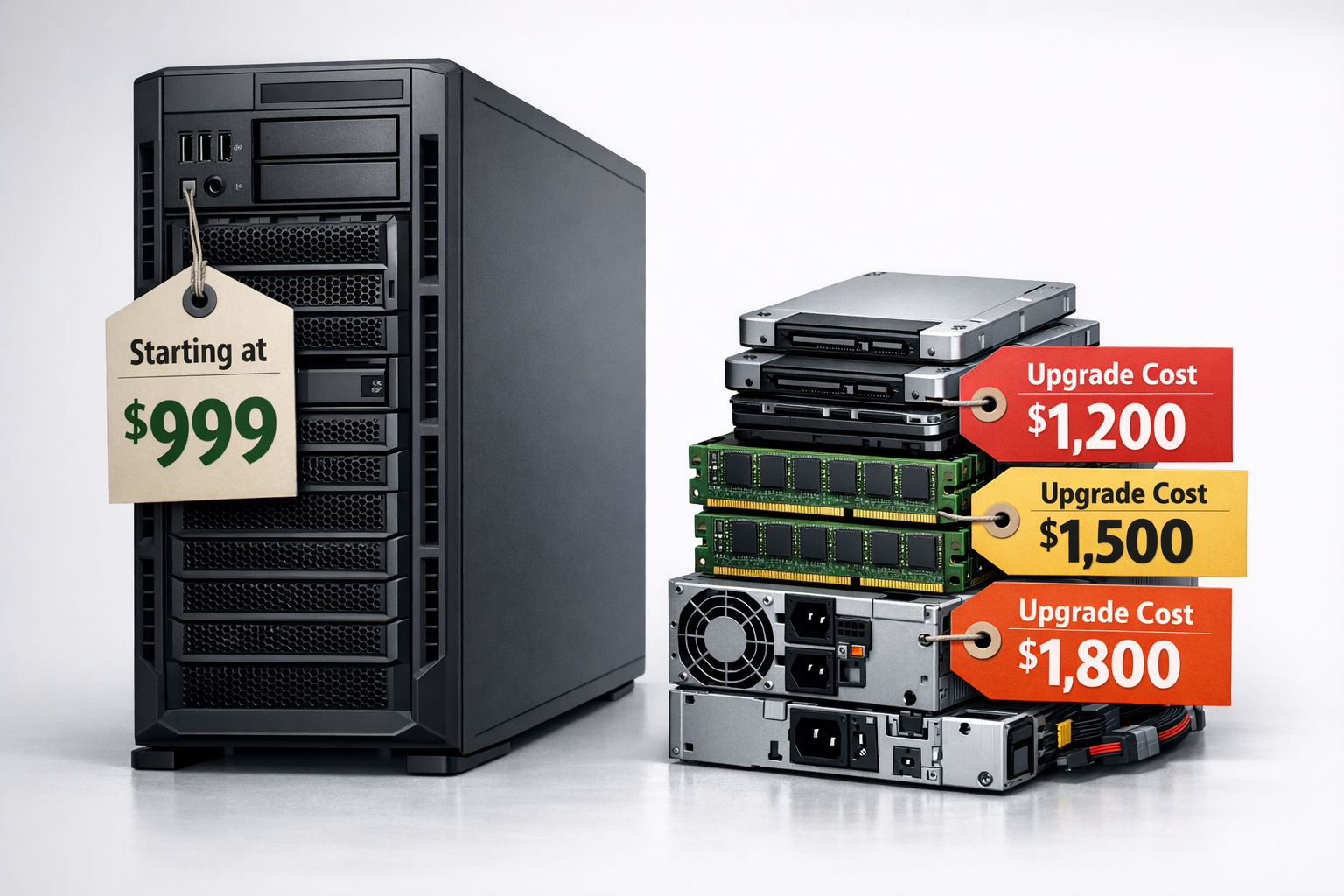
If you’ve ever searched online for a business server, you’ve probably seen prices that look surprisingly low — a few thousand dollars for “enterprise hardware,” or even dedicated servers advertised for under $200 per month. At first glance, it feels like servers should be inexpensive and straightforward to budget for.
But the reality is very different.
What most businesses see online doesn’t reflect what it actually costs to deploy a real, production‑ready server in an office environment. The listings that look cheap are usually incomplete, missing critical components, or referring to datacenter‑hosted machines that have nothing to do with onsite hardware.
In this article, we’re going to break down why server pricing is so misleading, what those low numbers really represent, and what goes into the cost of a fully built, reliable, and supported business server. By the end, you’ll understand exactly why quotes vary so widely — and what you’re truly paying for when you invest in a server that your business can depend on.
Why Server Pricing Is So Misleading (And How Businesses Get Burned)
Walk into any online marketplace and you’ll see “enterprise servers” listed for $1,500–$3,000. Scroll a little further and you’ll find dedicated servers advertised for $49–$199 per month. To a business owner, it looks like servers are cheap — so why does a real, production‑ready system cost $8,000–$30,000+ to buy or $600–$1200+ per month to lease?
Because the server market is one of the most misleading, confusing, and context‑dependent corners of IT.
Let’s break down why.
Most Servers Are Listed as Basic Models
When you see a Dell R740xd for $4,500, you’re not looking at a production server. You’re looking at:
- A bare chassis
- Maybe a motherboard
- Maybe a low‑end CPU
- Minimal RAM
- No RAID controller
- No enterprise SSDs
- No caddies
- No rails
- No warranty
It’s like buying a car with no engine, no transmission, and no wheels — technically a “car,” but not something you can drive.
A real server build requires:
- Dual Xeon CPUs
- 128–512 GB ECC RAM
- RAID controller with cache + battery
- 8–24 enterprise SSDs or NVMe drives
- Redundant power
- Proper cooling
- Rails, caddies, bezels
- Warranty + support
That’s where the real cost lives.
Silent Budget Killers
As an example, the Dell PowerEdge T360 has a starting price of around $4,500, which at first glance looks perfect for a small‑business budget. It feels like we’ve struck gold — until you look at what that base configuration actually includes. The entry model ships with 16 GB of RAM, a Pentium processor, and a single 1 TB 7.2K SATA hard drive. On paper it’s a “server,” but in reality, it would choke immediately under most of the small business application suite that require a server.
If your company is running this server as anything except a powerful workstation, that base T360 configuration simply cannot support this environment — not in performance, not in reliability, and not in storage throughput. To run your business applications properly, the server needs enterprise‑grade hardware, not entry‑level components. The base is not a realistic configuration for real world use.
What This Server Actually Needs
Upgrading the core system with TPM and an 8‑bay chassis immediately adds about $1,200 to the base price. From there, improving the CPU adds another $800, and topping off the RAM pushes the memory cost to roughly $4,000. None of this includes storage yet — and storage is where the pricing becomes completely unrealistic for a small business.
For example, a single 7.68 TB enterprise SAS SSD cost $23,900. To build a proper RAID‑10 array, you would need four of those drives if we are needing 10TB of usable drive space, instantly adding nearly $100,000 to the build. Even if we lower expectations and step down to 3.84 TB enterprise SATA SSDs, those still run around $12,500 each, and a proper RAID‑10 layout would require six of them. That’s $75,000 just for the drives.
At this point, the natural reaction is to abandon RAID‑10 and consider RAID‑5 instead. RAID‑5 only requires one parity disk, so with four drives you can get by with a smaller array. But even then, at $12,500 per drive, you’re still looking at $50,000 in storage alone. And that’s before adding a dual‑power‑supply configuration, which tacks on another $500.
Finally, none of this includes the Microsoft licensing required to actually run the environment. Between the Windows Server OS, Device CALs, and RDS licensing, you can easily add another $5,000 to the total cost.
This is the level of hardware required to deliver the uptime, speed, and reliability a modern small business expects — and it’s why the “starting price” on vendor websites is so misleading. The base model is never the model you can actually use.
Dedicated Server Pricing Online Is Not Comparable
I have had clients get confused with online pricing for servers when a “dedicated server” for $199/month, it’s not a physical server delivered to your office. It’s a server sitting in a datacenter rack the provider already owns.
They don’t:
- Buy new hardware for you
- Deliver anything
- Install anything
- Replace parts onsite
- Provide software support
- Handle your backups
- Touch your network
It’s similar to renting a hotel room — you get access, but you don’t own the building.
This is why onsite server leasing is 4–10× more expensive than datacenter hosting.
Licensing, Backups, and Virtualization Add Real Cost
A proper small‑business server isn’t just hardware. It needs:
- Windows Server
- Hyper‑V
- RDS (if remote desktops)
- Backups
- Offsite storage
- Monitoring
- Patching
- Warranty and parts replacement
These are not optional if you want uptime.
Businesses Compare Apples to Oranges Without Realizing It
Most misleading comparisons look like this:
| What They Think They’re Comparing | What They’re Actually Comparing |
|---|---|
| “Server for $4,500” | Bare chassis with no drives |
| “Dedicated server for $199/mo” | Datacenter rental, not onsite hardware |
| “My friend bought a server for cheap” | Old hardware with no redundancy |
| “Why does my quote say $18,000?” | Fully built, redundant, supported system |
Once you line up the details, the price difference makes perfect sense.
Server pricing only makes sense once you understand the workload.
Conclusion: The Real Cost of a Server
At first glance, a server like the Dell T360—with a starting price around $4,500—seems like a perfect fit for a small business. But once you add the RAM, storage, and the upgrades required to make it usable in a real environment, it becomes clear that the original budget needs to be adjusted. Manufacturers advertise the lowest possible price because they don’t yet know what the customer actually needs. They showcase the bare chassis, the weakest CPU, and the smallest drive because it grabs attention, but that number has nothing to do with what a real business requires for uptime, performance, and long‑term stability.
Choosing the right server isn’t about picking the cheapest model on a website. It’s about understanding your workloads, your growth plans, your applications, and your tolerance for risk. If you’re planning a server upgrade or trying to figure out what your environment truly needs, reach out. We’ll walk you through the options, explain the real costs, and help you build a solution that’s reliable, scalable, and aligned with your business goals.